

Strymon TimeLine MX Pedal
The Strymon TimeLine MX Pedal is the ultimate creative companion for players who love exploring new sounds. From warm vintage echoes to massive ambient washes and inspiring rhythmic textures, this pedal delivers incredible effects that bring every performance to life. It is a breeze to use, packed with powerful features, and built to handle everything from home practice to professional studio sessions and live shows.
Strymon TimeLine MX Review
The Strymon TimeLine MX Pedal represents the biggest evolution of Strymon's flagship delay pedal since the original TimeLine became a modern classic. Designed for musicians who demand exceptional sound quality and limitless creative options, the TimeLine MX combines classic delay tones with powerful new technology in a pedal that feels equally at home on stage, in the studio, or as the centerpiece of an advanced pedalboard. Whether you want subtle slapback echoes, vintage tape-inspired repeats, huge ambient washes, or completely experimental textures, this pedal delivers professional results while remaining surprisingly intuitive to use.
At the core of the TimeLine MX are twelve premium effect engines, including eleven delay machines and a dedicated reverb engine. Alongside enhanced versions of beloved TimeLine favorites like dTape, dBucket, Digital, Reverse, Ice, Filter, and Lo Fi, Strymon introduces several brand new engines that dramatically expand the pedal's capabilities.
The new Spectral Delay creates rich granular textures with pitch shifting, reverse playback, filtering, and time stretching for immersive atmospheric sounds. The Oil Can engine recreates the dark, murky character of vintage oil-can echo units, while the Drum engine captures the unique personality of classic magnetic drum echoes, with adjustable playback heads.
The Multitap engine makes it easy to build everything from simple rhythmic delays to complex layered patterns with individual control over level, panning, filtering, and feedback for each tap. Completing the collection is a luxurious reverb engine capable of producing everything from intimate room ambiance to expansive cinematic soundscapes.
One of the standout features of the TimeLine MX is its ability to run two effect engines simultaneously. Players can combine two different delays, layer delay with reverb, or create highly detailed stereo soundscapes using series, parallel, or split routing. Each engine can be edited independently and positioned anywhere within the stereo field, enabling incredibly wide and immersive sound. This flexibility opens up countless creative possibilities, from subtle enhancements that add depth to your tone to massive evolving textures that completely transform your playing.

The TimeLine MX is also designed with performance in mind. A bright OLED display provides clear visual feedback and makes navigating menus quick and simple, even on dark stages. The dedicated Tap Tempo footswitch keeps delay times perfectly synced during live performances while also providing instant access to the one-button looper mode for effortless layering. Players can assign footswitches to control each effect engine individually, giving them even greater flexibility without stopping to adjust settings between songs.
For musicians who rely on looping, the integrated five-minute stereo looper is a significant upgrade. It supports reverse and half-speed playback while allowing the looper to be placed before or after the delay effects. This gives players the freedom to capture clean performances before adding effects or record fully processed loops with all of the pedal's powerful sounds already applied. The simplified one-button looper mode also makes spontaneous looping during performances easier than ever.
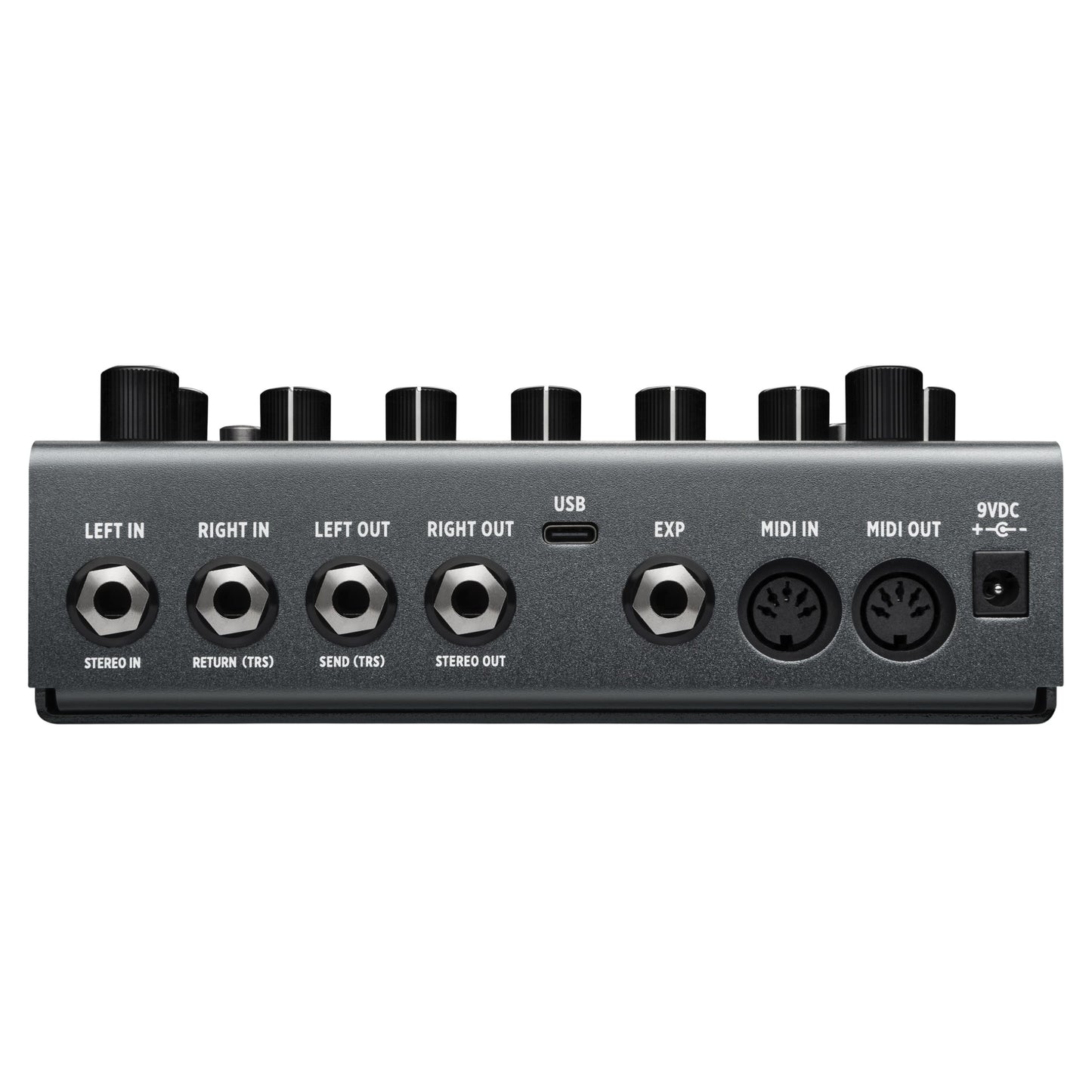
Connectivity is another area where the TimeLine MX excels. Stereo inputs and outputs, flexible routing options, configurable stereo send and return, full MIDI support through DIN, TRS, and USB-C, expression pedal compatibility, and integration with Strymon's Nixie 2 editor make it easy to incorporate the pedal into virtually any setup. Whether you are running a compact mono rig or an elaborate stereo system with multiple MIDI-controlled devices, the TimeLine MX adapts to your workflow with ease.
Under the hood, the pedal is powered by a high-performance tri-core 800 MHz ARM processor with 32-bit floating point processing and premium 24-bit, 96 kHz audio conversion. Combined with Strymon's analog dry path and discrete Class A JFET input stage, every note retains exceptional clarity, depth, and dynamic response while preserving the natural character of your instrument. The result is a delay pedal that sounds every bit as impressive in a professional recording environment as it does on stage.
With its remarkable sound quality, extensive collection of delay and reverb effects, powerful dual engine architecture, flexible routing, premium build quality, and musician-friendly design, the Strymon TimeLine MX Pedal sets a new benchmark for modern delay pedals. It is far more than an update to the original TimeLine. It is a complete reimagining that offers virtually endless creative possibilities for guitarists, bassists, and any musician looking to elevate their sound.
Strymon TimeLine MX Rumors
Before its official announcement, the Strymon TimeLine MX Pedal was the subject of plenty of speculation within the guitar community. Many players expected Strymon to release an updated version of the original TimeLine with faster processing, expanded routing options, and improved stereo functionality. Others hoped for long-requested additions such as dual delay engines, built-in reverb, a larger display, and a more flexible looper.

When the TimeLine MX was officially revealed, many of those rumors proved to be accurate. The pedal introduced powerful dual-effect processing, several brand-new delay engines, a dedicated reverb engine, a five-minute stereo looper, enhanced MIDI support, and expanded stereo routing options. Rather than simply refreshing the original design, Strymon delivered a major upgrade that exceeded many players' expectations and set a new benchmark for premium delay pedals.
Strymon TimeLine MX Release Date
The Strymon TimeLine MX Pedal officially released on July 7, 2026, marking the arrival of the next generation of Strymon's flagship delay pedal. Building on the success of the original TimeLine, the MX introduces powerful new delay engines, a dedicated reverb engine, dual effect processing, expanded stereo routing, and an upgraded user interface. Whether you're upgrading from the original TimeLine or stepping into premium delay effects for the first time, the July 7th release brings one of the most advanced and flexible delay pedals ever created.
TimeLine MX Strymon Features
- Create everything from vintage echoes to modern ambient soundscapes
- Use two effects at once for bigger and more creative tones
- Built-in reverb and a five-minute stereo looper add even more versatility
- Save your favorite sounds for quick access whenever you play
- Bright OLED display makes editing simple on stage or in the studio
- Flexible stereo connections fit easily into almost any guitar rig

Strymon TimeLine MX Multi Delay Effect Pedal Specs
- High-performance tri-core 800 MHz ARM processor
- 24-bit 96 kHz A/D and D/A conversion
- 32-bit floating-point processing
- Eleven delay engines plus a dedicated reverb engine
- Five-minute stereo looper with reverse and half-speed playback
- Stereo input and output
- Stereo send and return effects loop
- Analog dry path for zero-latency dry signal
- True bypass or selectable buffered bypass
- MIDI over DIN, TRS, and USB-C
- OLED display
- Input impedance 1 Meg Ohm
- Output impedance 100 Ohm
- Maximum input level +10 dBu
- Signal-to-noise ratio 116 dB typical
- Requires a 9V DC center-negative power supply
- Minimum current requirement: 500 mA
- Designed and built in the USA
Strymon TimeLine MX Delay Pedal Dimensions
- Height: 1.87 in.
- Width: 7.00 in.
- Depth: 5.00 in.
- Weight: 2 lbs
More From Strymon
Strymon TimeLine MX Delay Pedal FAQs
What is the Strymon TimeLine MX Pedal used for?
Can I use more than one effect at the same time?
Does it include reverb?
Is there a looper built in?
Can I use this pedal in a stereo setup?
Does it work with MIDI?
Is it suitable for live performances?
What kind of power supply does it need?
Can I connect it to a computer?
Is this an upgrade from the original TimeLine?